ADC development depends on tuning linker chemistry and drug-to-antibody ratio, then validating purity, stability and function across analytical and biological assays.
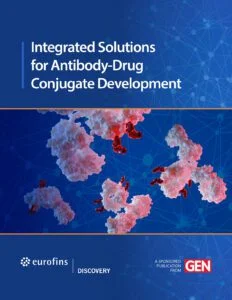
More than 100 antibody-drug conjugates (ADCs) are in clinical development, but a large pipeline doesn't make any one candidate straightforward to advance. Each ADC combines an antibody, which is intended to recognize a target, with a potent small-molecule payload. The challenge is to connect those parts in a way that preserves useful targeting while limiting effects beyond the intended target. That balance depends on linker chemistry, payload choice, conjugation strategy, drug-to-antibody ratio (DAR), stability and antibody integrity.
These variables are connected. A change in how a payload is attached can affect the mixture of molecules in a sample, which in turn shapes what analytical tests can establish. Testing also has to address more than whether the payload is present: teams need to understand the candidate's composition and examine its biological activity. This is a sequence of decisions, but not a simple one-way process. Results from characterization and functional studies can inform which designs deserve further comparison.
Design starts with chemistry
Linker-payload synthesis and bioconjugation set properties of the resulting ADC. Eurofins Discovery works with protease-sensitive, glycosidase-sensitive and pH-sensitive linkers, as well as PEGylated, branched and shielding designs. Those options reflect the fact that developers can vary how the antibody and payload are joined, and how the linker is designed to behave. Highly potent payloads are manufactured in specialized high-containment facilities.
The list of design options is not a recipe for a successful candidate. Each choice needs to be considered alongside the intended target and the properties the team wants to measure. A linker that behaves differently under particular conditions, for example, gives developers a distinct design to assess; the source doesn't establish that one linker type is generally superior. The useful question is whether the complete construct performs as intended, and what evidence supports that judgment.
Different conjugation options let developers compare ADC designs and tune pharmacokinetic profiles, stability and DAR distributions. Here's the thing: those choices shape what the downstream data can show, so early design and later characterization need to work together. A comparison is most informative when teams can relate differences in the construct to differences in measured properties, rather than treating synthesis and analysis as separate tasks.
That coordination matters because an ADC isn't just an antibody with a payload attached. The resulting material has properties that depend on both components and on the method used to join them. If you're working in this space, the design stage is where you set up the questions that later testing must answer. The chemistry is only the beginning.
Purity and DAR define what can be measured
After conjugation, chromatography methods remove unconjugated antibody, excess linker-payload material and aggregates. Purifying the sample supports more reliable downstream analysis and a clearer read on candidate performance. Without that step, components that aren't part of the intended ADC could complicate the interpretation of measurements. Sample quality, then, is part of the evidence behind a candidate comparison.
High-resolution liquid chromatography-mass spectrometry (LC-MS) then confirms payload incorporation, distinguishes individual DAR species and assesses ADC homogeneity. DAR describes the drug-to-antibody ratio, while the distribution of DAR species shows whether the sample contains ADC molecules with different numbers of attached payloads. A single summary value may not convey that variation, which is why distinguishing species can matter when teams compare designs.
These measurements help teams evaluate consistency, efficacy, safety and manufacturability. They don't, on their own, establish how a candidate will perform in every biological setting. Analytical characterization answers specific questions about what is in the sample; functional studies address different questions about what the ADC does. Keeping those roles clear helps prevent a clean analytical profile from being mistaken for proof of therapeutic value.
This is more significant than it looks: the quality of an interpretation depends partly on knowing what material was tested. If purity, DAR and homogeneity are understood, teams have a firmer basis for relating assay results to a particular ADC design. And yet, characterization is one part of a broader evaluation, not a substitute for it.
Functional testing guides candidate selection
Biochemical, functional and cytotoxicity assays assess binding, biological activity and therapeutic potential. In vitro and in vivo studies provide evidence to compare candidates and decide which merit further development. These tests examine different aspects of performance, so their value comes from considering the evidence together. A result from one assay may help explain another, but it cannot answer every question about a candidate.
The source describes a process that remains highly empirical. That means candidate selection depends on testing designs and interpreting the results, rather than relying on one property to settle the decision. Teams can use comparisons to identify which constructs merit further work, while recognizing that each finding applies to the conditions and assays used. No single measurement should carry more weight than the question it was designed to answer.
Eurofins Discovery’s integrated platform covers linker-payload design, conjugation, purification, analytical characterization and functional assessment. Its stated aim is to reduce development risks and timelines while helping optimize ADC safety, efficacy and manufacturability. Those are goals, not guarantees; the practical value of an integrated offering depends on how effectively each stage informs the next.
For teams navigating a still highly empirical process, the practical takeaway is that chemistry, analytics and biological testing need to inform one another from the start. A well-organized workflow can make comparisons easier to interpret, while leaving the scientific evidence to determine which candidates advance. What this means for you: look for a clear connection between the construct, the measurements and the decisions those measurements support.
Why the workflow matters
ADC development brings together design choices that are easy to describe separately but difficult to evaluate in isolation. Linker behavior, payload attachment, DAR distribution, sample purity and biological activity all contribute to the picture. The value of a connected workflow is that it lets a team examine those elements in relation to one another, then use the findings to guide candidate selection.
(And this is the part most people overlook.) More testing doesn't automatically produce a clearer decision if the results can't be tied back to the material and design being assessed. The sequence described here offers a way to make that connection: characterize the conjugate, measure its activity and compare candidates using evidence from both. For an expanding field, disciplined interpretation may be as important as the breadth of available design options.
There are no shortcuts implied by the number of ADCs in development or by the availability of multiple linker and conjugation approaches. Each candidate still has to be assessed on its own properties. The central point is straightforward: decisions made during design affect what can be learned later, so teams benefit when chemistry, analytical work and functional testing are planned as parts of the same effort.
The post ADC Development from Concept to Clinic appeared first on GEN - Genetic Engineering and Biotechnology News.


Discussion
Sign in to join the discussion.