Kyushu University researchers traced how a peptide and neural circuit erase a specific odor memory in C. elegans while preserving another.
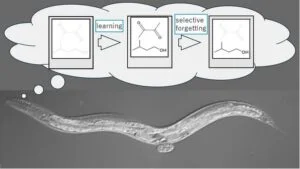
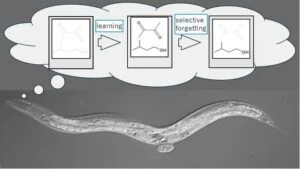
A small nematode can erase one learned odor while retaining another, and researchers have traced the process to a specific chain of neurons and chemical signals. The finding gives scientists a detailed model of active, selective forgetting, a part of memory biology that has received less attention than memory formation and storage.
The work comes from a Kyushu University team led by Professor Takeshi Ishihara, with PhD candidate Yuuki Onishi as first author. Their study identifies a signaling sequence in Caenorhabditis elegans: AWC neurons release the peptide NLP-47, which activates the GNRR-1 receptor on AIZ interneurons. Those cells then use glutamate to signal to AWA neurons, where the odor memory is stored. The final signal acts through the GLR-4 receptor and promotes erasure of that memory.
A circuit that can target one memory
The most revealing result is the circuit’s selectivity. When the worms learned diacetyl and isoamyl alcohol at the same time, the pathway reduced the diacetyl memory while leaving the isoamyl alcohol memory intact. The researchers therefore describe forgetting here as a regulated process that can act on a particular learned experience, rather than a general loss of stored information.
That distinction matters because forgetting is often treated as a breakdown in memory. Ishihara argues that it also serves a normal function: animals need to discard experiences that no longer help them respond to their surroundings, while preserving useful ones. The study addresses a basic question behind that idea: how can a nervous system remove one memory without wiping out others?
“There are many diseases that involve memory loss,” Ishihara said. “But before we can understand what goes wrong, we need to understand how forgetting works in the brain, and I hope this research will lead to a better understanding of such brain functions.” The authors say the work may inform research into disorders associated with dysregulated forgetting, including dementia and PTSD. It does not establish how those conditions work; its contribution is a defined mechanism in a simple animal model.
Tracing the signal from odor to erasure
C. elegans has just 302 neurons, each of which has been identified. That compact nervous system makes it possible to follow a behavior through specific cells with unusual precision. The worm is blind but has a strong sense of smell, and its response to attractive odors gives researchers a way to test whether it remembers a learned scent.
Ishihara’s group had already identified part of the pathway in a 2013 study. That work found that AWA neurons hold the memory of a specific odor and that signals from AWC neurons can trigger its forgetting. The missing piece was the molecular signal connecting those cells. The new research identifies NLP-47, its receptor GNRR-1, and AIZ neurons as intermediaries in the circuit.
To test odor memory, the team trained worms to associate the scent of diacetyl with an experience. The researchers then presented the odor again after about four hours, the usual period in which the worms forget it. Movement toward the scent indicated that the memory had faded; a failure to approach indicated that it remained. This behavioral test let the team compare forgetting across worms with different parts of the pathway functioning or suppressed.
The experiments identified NLP-47 as a peptide released by AWC neurons and GNRR-1 as its receptor on AIZ interneurons. The AIZ cells sit between AWC and AWA in the circuit. Once activated, they release glutamate, which acts on GLR-4 receptors on the AWA neurons that store the odor memory. In the researchers’ account, this sequence carries the forgetting signal from the initiating cells to the memory-bearing cells.
Optogenetic experiments added evidence that the cells participate in active forgetting. When the team suppressed AWC and AIZ activity with this technique, the worms became more resistant to forgetting. Worms in which NLP-47, GNRR-1, or glutamate signaling did not function also retained the odors more readily. Together, those results support a pathway in which peptide and glutamate signals are required for the observed memory loss.
What the worm model can—and can’t—show
The two-odor experiment puts the pathway’s apparent specificity in focus. Simultaneous conditioning with diacetyl and isoamyl alcohol did not lead to equal forgetting: the NLP-47/GNRR-1 route selectively promoted loss of the diacetyl memory. Onishi said the team had not expected to find such a concrete mechanism with this degree of specificity. The result suggests the nervous system can regulate the fate of individual memories, at least under the conditions tested in the worm.
The researchers also point to a possible connection beyond nematodes. GNRR-1 is an orthologue of the human GnRH receptor, and related receptors are found in other organisms. Ishihara noted that these receptors occur in the hippocampus of rodents, a brain region associated with memory, although their role there remains unknown. The presence of a related receptor makes the pathway a question for further study; it does not show that mammals use the same circuit or erase memories in the same way.
The paper, published in Current Biology, is titled “Neuropeptidergic-glutamatergic circuit regulates selective forgetting of olfactory learning.” Its central contribution is a molecular and neural framework that links a specific odor memory to a defined forgetting signal. The next challenge is to determine whether comparable mechanisms operate in more complex nervous systems, where memories involve many cells and experiences overlap.
For now, the study makes a useful point about memory research: loss of a memory need not mean that the brain has failed to preserve it. In C. elegans, at least, a short chain of signals can direct the removal of one learned odor while another remains available. Establishing whether that kind of precision carries over to other animals will take further work.
The post Lost and Found: Neural Pathway for Forgetting Found in <i>C. elegans</i> appeared first on GEN - Genetic Engineering and Biotechnology News.



Discussion
Sign in to join the discussion.