David Liu pointed to advances in prime editing, AI-designed editors and suppressor tRNAs as routes to treating more genetic diseases with fewer therapies.

Gene editing’s next test may be whether one treatment can address many mutations. At the European Society of Gene & Cell Therapy (ESGCT) 2026 meeting in Hamburg, David Liu argued that progress in precision editing, machine learning and clinical development could help widen the field’s reach beyond rare, mutation-specific therapies.

The scale of the problem gives that goal its urgency: more than 200,000 known mutations are associated with about 8,000 genetic diseases, which affect roughly 400 million families. Liu’s central argument was that scientific advances alone won’t be enough. Different editing methods need to work alongside improvements in regulation, manufacturing and economics to make treatments practical for more patients.
Liu, who spoke at ESGCT in Barcelona in 2019 (GEN coverage), opened with a field-wide “meta lesson”: research approaches and applications can reinforce one another, while progress in other parts of drug development helps carry discoveries toward patients. The plenary’s opening speaker, 2018 Kavli Award winner Virginijus Siksnys, joked that he was “just the warm up for David.”
AI targets prime editing’s weak points
Two projects from Liu’s lab showed how machine learning could help refine prime editing. One, published a few months before the meeting in Nature Biotechnology (paper), used ProteinMPNN to improve prime editor properties.
The lab had used phage-assisted continuous evolution, or PACE, in 2023 to produce PE6 editors with greater activity. But those variants came with trade-offs: they tended to have lower stability and expression. ProteinMPNN is designed to tackle the inverse protein-folding problem, proposing sequences that can fold stably into a specified structure. The researchers used it to redesign as much as 25 percent of the reverse transcriptase amino acids in prime editors. The resulting PE8 variants showed stronger expression and editing efficiency across different cell types.
A separate paper introduced OptiPrime, a free machine learning tool for predicting prime editing outcomes (paper). Liu joked that the team couldn’t call it “Optimus Prime” because “Hasbro would sue us.” The tool addresses a practical design problem: each prime editing guide RNA, or pegRNA, has multiple variable regions, and those choices can substantially affect editing efficiency.
For a desired edit, researchers may have hundreds of possible pegRNA designs to consider. OptiPrime ranks candidate sequences, and users can generate a list through the OptiPri.me website. The information can then be copied into an online order form for a gene synthesis service. That workflow turns a large design search into a more directed experimental starting point.
Clinical milestones change the conversation
A decade after the first landmark base editing report, and seven years after prime editing was described, Liu sees a growing body of evidence that precise edits can correct disease biology. He cited nine animal-model examples, representing what he estimated to be a century of work, in which precision editing rescued disease phenotypes. The examples included progeria, sickle cell disease, cystic fibrosis, phenylketonuria and spinal muscular atrophy.
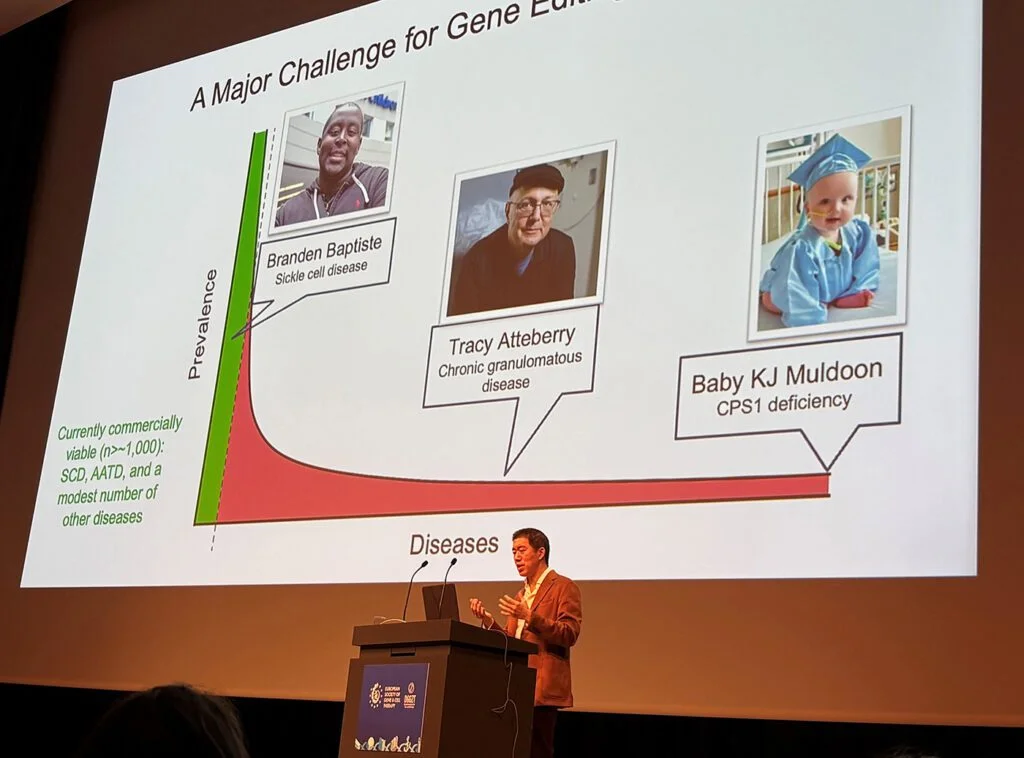
Several programs have also moved toward clinical testing. In March 2025, Beam Therapeutics reported the first clinical correction of a human pathogenic mutation, in a person with alpha-1 antitrypsin deficiency treated with BEAM-302. Around the same time, the case of Baby KJ drew attention to bespoke base editing and the possibility of designing a treatment for an individual patient’s mutation (coverage).
Prime editing has reached patients as well. In April 2025, 57-year-old Tracy Atteberry became the first person dosed in an ex vivo prime editing trial. She received stem cells edited to repair a two-base gene deletion; the study was reported later that year by Jennifer Gori, PhD, and colleagues (report). In October, the first participant was dosed in an in vivo prime editing trial for Wilson disease, known as PM577a.
Liu said he was optimistic about the general direction of regulatory policy in the U.S., U.K. and elsewhere, describing authorities as “not standing in the way.” The day before his talk, the U.S. Food and Drug Administration issued draft guidance on individualized human genome editing products and considerations for biologics license applications and postapproval management (guidance).
One editing strategy, several diseases
The most direct route Liu described toward treating multiple diseases with a single therapy uses suppressor transfer RNAs. Around 30 percent of genetic diseases involve at least one premature stop codon. These mutations prematurely halt protein production; a suppressor tRNA can read through the stop signal and allow a full-length protein to be made. Liu’s lab has been exploring this strategy as a way to reach more mutations with fewer drugs (earlier report).
“A tRNA approach enables far fewer drugs to target a larger number of mutations/diseases,” Liu said. His group’s approach, called prime editing-mediated readthrough of premature termination codons, or PERT, uses prime editing to convert a tRNA gene into a permanent suppressor tRNA. The goal is to make one treatment relevant to multiple diseases that share the same premature stop codon.
The human genome contains 418 tRNA genes, even though translation uses 61 coding triplets. Liu pointed to the redundancy as a possible opening: people can lack at least one tRNA gene, suggesting that some can be altered without disrupting normal function. The lab, led in this work by postdoctoral researcher Sarah Pierce, PhD, used prime editing to engineer the anticodons of all 418 tRNAs to recognize the three stop codons: CUA, UCA and UUA.
In research described in a 2025 paper, the team focused on a leucine tRNA that showed the highest suppression activity, then converted it into an optimized suppressor. Liu said the researchers aren’t overexpressing it. They replace the original tRNA and produce about 40 percent of its previous amount, a design intended to support suppression while avoiding excessive expression.
The most promising results so far came from applying PERT in a mouse model of Hurler syndrome. Treatment produced about 7 percent of normal enzyme activity, a level Liu suggested could be enough to rescue the disease. The result is early, but it gives the team a concrete test of whether a shared molecular strategy can extend beyond one mutation.
Reach depends on lowering the cost of rare-disease work
Liu’s optimism came with a practical constraint. Even as new editing approaches broaden the possible patient population, he said most genetic diseases remain too rare for industry to pursue unless regulatory streamlining and clinical risk reduction continue to bring down development costs. His closing emphasis was on making gene editing applicable to more patients, while recognizing that technical performance is only one part of that equation.
One effort aimed at the access problem is the nonprofit Center for Therapeutic Genetics, established by researchers at the Broad Institute, Boston Children’s Hospital and The Jackson Laboratory (announcement). Liu said the group hopes the model will be “mimicked everywhere” to connect people with rare diseases to potential treatments. Apertura, Viralgen, Beam Therapeutics and Prime Medicine provided initial commercial support.
The field’s next measure of progress will be whether advances such as PE8, OptiPrime and PERT can translate into treatments that serve more than a single mutation or a small set of patients. Liu’s examples suggest that the tools are beginning to align; broad clinical reach will depend on whether that alignment can make rare-disease development workable.
The post No Nonsense: David Liu Lauds Progress in Disease-Agnostic Gene Editing at ESGCT appeared first on GEN - Genetic Engineering and Biotechnology News.


Discussion
Sign in to join the discussion.