As AAV therapies advance toward commercialization, integrated manufacturing and supply planning will shape how reliably developers can deliver them at scale.
AAV gene therapies have shown clinical promise for rare and genetic diseases. The next test is operational: developers need to make these therapies reliably, expand production and sustain supply as programs move toward market. Clinical efficacy alone won’t determine whether treatments can reach patients at scale. A therapy can work in a clinical setting and still face a difficult path if the process used to make it can’t deliver consistent material in the quantities a wider rollout requires.
Planning for commercial supply
Demand is rising, while manufacturing capacity remains constrained. That combination puts pressure on developers to think beyond whether a process can support an early clinical program. They also have to consider whether it can be repeated consistently, expanded as needs change and connected to a dependable supply chain. The commercial question is not simply how much can be made in one production run; it’s whether manufacturing and supply arrangements can support the program over time.
Global supply chains add another layer of coordination. Materials, production planning and delivery timelines all have to line up, and a disruption in one part can affect the rest. Similar complex manufacturing programs typically benefit from identifying dependencies early, while there’s still room to adjust plans. That work can’t remove every source of delay, but it can make problems easier to spot before they reach patients.
Developers also have to prepare for commercial requirements well before registration and launch. Methods that served a program in early clinical development may not hold up as production needs grow. Changes to a process can bring additional work to demonstrate that output remains consistent, so decisions made early can shape the effort required later. This is more significant than it looks: a development choice that appears efficient at small scale may create friction when a program needs greater output.
That puts a premium on coordinated planning. Platform technologies, integrated development strategies and more resilient supply chains can help shorten timelines while supporting consistent manufacturing. Early commercial planning may also help prevent delays later in development. The point isn’t that planning guarantees a smooth path; it’s that waiting until launch is near can leave fewer practical options for addressing a bottleneck.
Reducing bottlenecks across development
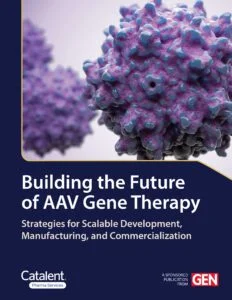
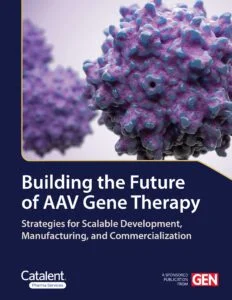
A new eBook gathers perspectives from across AAV development and manufacturing. It considers how standardized platforms and off-the-shelf plasmids can simplify development, and how newer manufacturing approaches may address persistent capacity bottlenecks. It also looks at supply chain coordination and case management as parts of getting therapies to patients safely and on schedule. These topics are connected: decisions about materials and production can affect how a program organizes its supply and delivery work.
Standardization can make parts of development more repeatable, but it doesn’t remove the need to assess whether a given approach fits a particular program. Off-the-shelf plasmids, for example, are presented as one way to simplify development; the broader value of standardized tools is that teams may be able to spend less effort rebuilding common parts of a process. The trade-off is familiar across technical fields: a shared platform can reduce variation in routine work, while program-specific needs still require attention.
Manufacturing approaches aimed at capacity bottlenecks matter for a similarly practical reason. If production can’t keep pace with a program’s needs, clinical progress may not translate into reliable availability. But describing an approach as newer doesn’t, by itself, establish how well it will perform at larger scale. Developers need to connect manufacturing decisions with evidence about consistency and supply, then plan around the limits they can identify.
Where coordination matters
Supply chain coordination and case management can sound like supporting tasks beside the science. They’re part of the route between making a therapy and getting it to a patient. When timelines, materials and handoffs aren’t aligned, operational gaps can complicate delivery even when the underlying treatment has shown promise. (And this is the part most people overlook.) The patient-facing outcome depends on a chain of work, not on manufacturing in isolation.
If you’re working in this space, the practical question is whether development, manufacturing and supply teams are planning against the same needs. A production strategy that isn’t connected to supply planning may leave important dependencies unresolved. Likewise, plans built around early clinical demand may need revision as programs advance. Clear coordination won’t erase uncertainty, but it can help teams see where assumptions about capacity, timing or materials need a closer look.
What the shift toward commercialization means
As more AAV programs approach commercialization, the ability to connect manufacturing choices with supply planning will shape how well companies can serve patients. The practical focus is clear: build scale, consistency and supply resilience into development early, rather than treating them as launch-stage problems. That requires attention to both the process and the system around it: how production can grow, how dependable inputs will be and how teams will manage the path to delivery.
The eBook’s themes point to a broader operational challenge for the field. Progress will depend in part on whether developers can turn promising programs into repeatable production and dependable supply. The numbers here are underwhelming in one respect: the source offers no figures for capacity, timelines or output, so it can’t show how much any proposed approach might change. Its value is in framing the work that needs attention. Scale, consistency and coordination. Those are development questions now, with consequences that extend to commercial supply.
The post Building the Future of AAV Gene Therapy appeared first on GEN - Genetic Engineering and Biotechnology News.



Discussion
Sign in to join the discussion.